
| Download Document |
 |

|
Terms to Know
- Landings: Landings are how you arrive to the visitor sites. Each site is visited by dinghy, also known as zodiac or panga.
- Panga: Panga is the Spanish term for dinghy or zodiac. You will hear this word often.
- Dry Landing: Upon arrival to the visitor site you will not have to enter the water when exiting the zodiac or dinghy.
- Wet Landing: Upon arrival to the visitor site you will exit the dinghy by entering the water first, then walking ashore.
- No Landing: There will be no landing because activity will consist of panga ride or snorkeling.
- Dinghy Ride: The dinghy ride is a simple ride on the water around the visitor area. This is done when there is no landing permitted or to get a better view of nearby wildlife or landscapes.
- Possible Activities: All activities are to be ultimately decided by the guide considering weather, sea conditions, and other factors.The activities listed in all itineraries are the final decision made by the Galapagos national park officials with the best interest of the islands in mind. These cannot be altered in any way.
Saturday to Saturday
Day 1 (Saturday)
ARRIVAL TO BALTRA & BACHAS BEACH (SANTA CRUZ ISLAND)
Assistance will be provided upon your arrival by a Cormorant representative after passing through immigration and baggage claim. When ready, you will be transferred to the yacht. You will then be shown to your cabin where you will have some time to settle in before the welcome briefing and lunch.
The afternoon visit, Bachas Beach, is located on the north shore of Santa Cruz, and is a great swimming beach. One of the few remnants of the U.S. World War II, a floating pier, presents its self here. You may see flamingos, Sally-Lightfoot crabs, hermit crabs, Black-Necked stilts, and whimbrels. Sea turtles also nest off the beach.
| BACHAS BEACH | |
| Difficulty: | Easy |
| Type of Landing: | Wet landing |
| Highlights & Animals: | World War II remnants, Sally-Lightfoot crabs, hermit crabs, Black-necked Stilts, whimbrels, and sea turtles. |
Day 2 (Sunday)
PINNACLE ROCK (BARTHOLOMEW ISLAND) & SULLIVAN BAY (SANTIAGO ISLAND)

Our morning visit includes Bartholomew Island, home of the famous Pinnacle Rock. Bartholomew consists of an extinct volcano with a variety of red, orange, black and even green volcanic formations. We will take a trail of stairs to the summit of the volcano (about 30 or 40 minutes), where you will enjoy one of the best views of the islands! You will also visit a small, beautiful beach, surrounded by the only vegetation found on this barren island. The beach is perfect for snorkeling where you may even see the Galapagos penguins.
| PINNACLE ROCK | |
| Possible Activities: | Dinghy ride, snorkeling & hike (1.2 mi / 2 km) |
| Difficulty: | Moderate/Difficult. Walk up to the top of volcano 114 meters, 375 wooden steps. |
| Type of Landing: | Dry and Wet Landing |
| Highlights & Animals: | Pinnacle rock, panoramic view, moonlike landscape, penguins, pioneer plants, lava cactus, snorkeling, penguins, reef sharks, sting-rays, and a variety of colorful fish. |
In the afternoon we will head for Sullivan bay. This site, located southeast of Santiago Island, is of great geological interest. The area is covered by Pahoehoe lava flows (solidified lava in corrugated or accordion form). It was very active in the last 25 years of the nineteenth century. The Sullivan lava formed in 1897. This flow is geologically very young. The magma formed is flat, but the movement of underground lava, and rapid cooling and other eruptions led to the break in many places. 200 meters around the landing, you can see patterns of vegetation that were burned during the eruption. A visit to this area of black lava is preferable in the afternoon because the temperature is more pleasant and the light is better for photographs.
| SULLIVAN BAY | |
| Possible Activities: | Hike (1.3 mi / 1 1/2 km) swimming and snorkeling. |
| Difficulty: | Moderate: The lava is very hot due to the sun, be sure to have thick-soled shoes. |
| Type of Landing: | Dry landing at the rocky shore and a wet landing at the white sand beach. |
| Highlights & Animals: | Pahoehoe lava flows, which have hardened in accordion like formation. Small glass-like bubbles of lava can be found, called "hornitos". Swimming with sea lions and other wildlife from the shore is a lovely way to finish off the tour. |
Day 3 (Monday)
SOUTH PLAZAS ISLAND & SANTA FE ISLAND

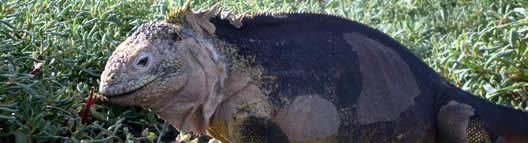
In the morning, you will head to South Plaza Island. This small island with steep cliffs was formed by rising lava and is now covered by Opuntia cacti. It is also home to one of the largest sea lion colonies as well as colorful yellow and red land iguanas. The most characteristic plant is the Sesuvium. During the rainy season its color is a greenish to yellowish tone and in the dry season (end of June through January) a bright red.
| SOUTH PLAZA ISLAND | |
| Possible Activities: | Hike (1.5 mi / 2 km) |
| Difficulty: | Moderate |
| Type of Landing: | Dry landing |
| Highlights & Animals: | Land iguanas, sea lion colony, Audubon's shearwaters, Swallow-tailed Gulls, Nazca Boobies and amazing landscape with cliffs. |
Our afternoon visit is to Santa Fe Island, formed by a volcanic uplift. Santa Fe (Barrington) is home to the small picturesque bay and anchorage on the island northeast coast. The bay has two visitor trails, one leading to a scenic viewpoint atop a cliff and the other spanning from a small beach to a tall prickly pear cactus forest. The island is home to a colony of sea lions which would be more than happy to join you for a swim. Santa Fe also has its own sub-species of land iguana.
| SANTA FE ISLAND | |
| Possible Activities: | Hiking and swimming |
| Difficulty: | Moderate |
| Type of Landing: | Dry landing |
| Highlights & Animals: | Land Iguanas, giant tunas, sea lions. |
Day 4 (Tuesday)
WITCH HILL & PITT POINT (SAN CRISTOBAL ISLAND)

We will visit Witch Hill (Cerro Brujo) in the morning where you will explore one of the nicest beaches in the Galápagos. You'll be tantalized by the texture and sight of the powdered, soft, white sand. With a colony of sea lions and Blue-footed Boobies, this scenic place is bustling with life. Just beyond the beach is a lagoon, thriving with Egrets and Great Blue Herons. The turquoise water and abundant marine life will invite you to snorkel their midst.
| WITCH HILL | |
| Possible Activities: | Hike, dinghy ride, snorkeling & kayaking |
| Difficulty: | Easy walk along the beach |
| Type of Landing: | Wet Landing |
| Highlights & Animals: | Beautiful rock formations, sea lions, shore-birds, and land birds: finches and mockingbirds. Snorkeling: spot tropical fish, anemones, sponge coral. |
In the afternoon we will visit Pitt Point. Pitt Point holds its own as the northeastern most site on Isabela. After an easy hike, you will be rewarded with a unique treat. Herein lays the only nesting site which hosts all species of Galápagos Boobies. Photographers will be thrilled with this intimate natural experience. The attractive volcanic tuff formations will have geologists and laymen alike imagining the forces of nature that possessed the earth to create this land.
| PITT POINT | |
| Possible Activities: | Dinghy ride, snorkeling, kayaking & hike (1.5 mi / 2 1/2 km) |
| Difficulty: | Moderate/Difficult |
| Type of Landing: | Wet landing |
| Highlights & Animals: | Wonderful landscape, sea lion colony, three possible species of Boobies. |
Day 5 (Wednesday)
LOBOS ISLAND & KICKER ROCK (SAN CRISTOBAL ISLAND)
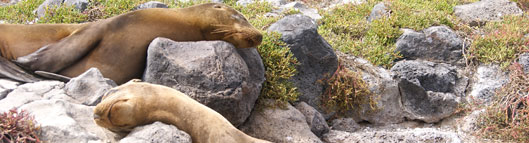
In the morning we will visit Lobos Island, a rocky bay just a 30 minute walk from Puerto Baquerizo. Note the beautifully colored plants in the area down by the beach and the enormous colony and nursery that Galapagos sea lions call home. Sea lions are normality here where dozens can be seen at any time as well as shore birds and marine iguanas.
| LOBOS ISLAND | |
| Possible Activities: | 30 minute walk |
| Difficulty: | Easy / Moderate |
| Type of Landing: | Dry Landing |
| Highlights & Animals: | Sea lion colony, shore birds, unique colored plants, marine iguanas. |
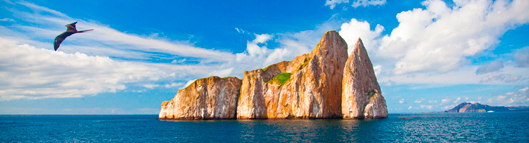
In the afternoon you'll enjoy a dinghy ride and snorkeling around Kicker Rock (Leon Dormido), known as the Sleeping Lion because of its resemblance, this site is located off the coast of San Cristobal. The remains of a lava cone eroded by the sea, and two vertical rocks rising 500 feet above the ocean, form a small channel that is navigable by small boats. This Galapagos Islands natural monument has become a favorite sight for cruises due to the many tropicbirds, frigatebirds and boobies that fill the surrounding air. Beneath the sea the crystal waters offer a brilliant show of colorful tropical fish and invertebrates.
| KICKER ROCK | |
| Possible Activities: | Snorkeling & Dinghy Rid |
| Difficulty: | Easy |
| Type of Landing: | No Landing |
| Highlights & Animals: | Deep water snorkeling: Sharks, tropical fish, turtles, manta rays (occ.), hammerhead sharks, and spectacular rock formations. Sea birds: Blue-footed Boobies, Nazca Boobies & frigatebirds. |
Day 6 (Thursday)
SUAREZ POINT & GARDNER BAY / OSBORN ISLET (ESPAÑOLA ISLAND)
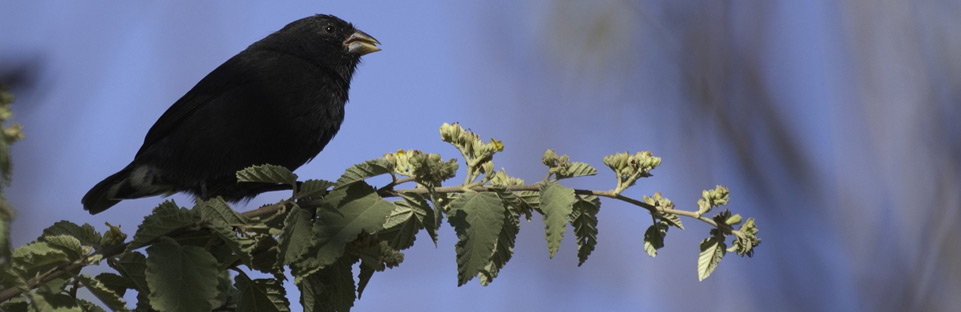
Española Island is the southernmost island of the Galapagos and is the breeding site of nearly all of the Waved Albatrosses in the entire world. Española is densely populated with mockingbirds, Blue-footed and Nazca Boobies, Darwin finches, Galapagos doves, hawks, red and green marine iguanas, and loads of sea lions.
In the morning we will arrive at Suarez Point. This area is great for spotting Blue-footed Boobies, albatrosses and Nazca Boobies. A beautiful site on the ocean front, the large Waved Albatrosses use the cliff as a launching pad. The famous attraction is the magnificent blowhole, spurting water high into the air. This site presents wonderful photographic opportunities!
| SUAREZ POINT | |
| Possible Activities: | Hike (1.9 mi / 3 km) |
| Difficulty: | Difficult |
| Type of Landing: | Dry Landing |
| Highlights & Animals: | Hood mockingbird, Nazca Boobies, Waved Albatross, Red-billed tropicbirds, lava lizards, Galapagos Hawk, Blue-footed Boobies, blow hole, amazing landscape. |
Gardner Bay, on the eastern side of the island, is the breeding site of nearly all of the world's 12,000 pairs of Waved Albatrosses. It has an ample white sandy beach with a myriad of sea lions, perfect for relaxing. Its rocky shores make this site a great place for diving and snorkeling.
| GARDNER BAY / OSBORN ISLET | |
| Possible Activities: | Snorkeling, dinghy ride, kayaking, short hike of (0.6 mi / 1km) |
| Difficulty: | Easy |
| Type of Landing: | Wet landing |
| Highlights & Animals: | White sandy beach, sea lions, and mockingbirds. Snorkeling: colorful fish, sea lion nursery |
Day 7 (Friday)
CORMORANT POINT / CHAMPION ISLET &
POST OFFICE BAY/ BARONESS VIEW POINT (FLOREANA ISLAND)

We will visit two sites on Floreana Island. Floreana is known for its fabulous snorkeling sites, its vibrantly pink flamingos and its black sand beaches.
We will head to Cormorant Point in the northern part of Floreana. Here, land on a green colored beach from the olivine crystals it is composed of. Enjoy a hike to a salt-water lagoon which is home to flamingos and other sea birds. The trail continues to another beach known as Flour Beach because of the very fine white-sand particles it is made of, it is also really important to turtles that nest there. You will also get to swim in Champion Islet, one of the best snorkeling sites in the Galapagos Islands.
| CORMORANT POINT / CHAMPION ISLET | |
| Possible Activities: | Hike, Dinghy Ride & Snorkeling (1.2 mi / 2km) |
| Difficulty: | Easy |
| Type of Landing: | Wet Landing |
| Highlights & Animals: | Sea lions, flamingos, rays, olive crystals, rock formations. |
In the afternoon, we will visit the famous Post Office Bay and Baroness View Point. You will land on a beach and head to a spot where 18th century whalers once placed a wooden barrel for use as an unofficial mail box. The custom continues to this day with Galapagos visitors. So, don't forget your postcards, and don't be surprised if the post card arrives to its destination before you even get home!
Baroness View Point- On the northern part of the island, Baroness Lookout Point has a beautiful landscape and historic view. It was named after the supposed Austrian Baroness that was the subject of many mysterious disappearances and well-known stories of loathing by those on Floreana.
| POST OFFICE BAY / BARONESS VIEW POINT | |
| Possible Activities: | Short hike (less than 0.6 mi / 1km) & snorkeling, historical views |
| Difficulty: | Easy |
| Type of Landing: | Wet Landing |
| Highlights & Animals: | Barrel Post Office, nice sandy beach, Mangrove forest, great views of coastline. |
Day 8 (Saturday)
CHARLES DARWIN RESEARCH STATION & DEPARTURE

In the morning we start at the Charles Darwin Station- Breeding Center "Fausto Llerena" home to turtles ranging from 3-inches (new hatchlings) to 4-feet long. Here you will observe the various sub-species of turtles interacting with each other, and possibly with you. Many of the older turtles are accustomed to humans. The babies are only kept until they are about four years old, or large enough to survive in the wild. These conservation efforts continue to be extremely successful.
| CHARLES DARWIN RESEARCH STATION | |
| Possible Activities: | Walking |
| Difficulty: | Easy |
| Type of Landing: | Dry landing |
| Highlights: | Giant Tortoises, land and marine iguanas, variety of birds |
Transfer to Baltra Airport
Your cruise has officially come to an end. We hope you enjoyed your Galapagos Cruise! We will now transfer you to your scheduled departure from Baltra Airport to mainland Ecuador. Safe travels!
Important: Itineraries and activities subject to change without prior notice. Depending on weather conditions and water currents, some wildlife described above may not be visible. The wildlife described is not guaranteed to be seen during your visit. Please remember to respect your distance between any and all wildlife. Please stay on marked trails and heed the directions of your Naturalist Guide. |
