
Super El Niño continues to threaten Ecuador and the Galapagos Islands
Since early this year, climatologists and oceanographers have been tracking an increasingly strong El Niño phenomenon growing in the tropical Pacific. While this event happens every 2-7 years, a strong event like this one only occurs every 15-20 years. Based on comparisons of this year’s trends to previous years, the 2015 ENSO looks to rival the super-El Niño that struck in 1997-98.
An El Niño happens when ocean currents die down, upwelling from the depths of the ocean weakens, and air pressure around South America goes down while it rises in the Asian Pacific. These events form a self-strengthening cycle in the equatorial Pacific that leads to heavier-than-normal rains, high humidity, and a series of environmental and human risks associated with these conditions in the tropical coastal zones of South America.
Forecasting an El Niño Phenomenon
The original forecasts predicted that the rains and humidity would begin in early November, but recent reports have estimated that they will arrive closer to December. Of course, predicting such a complex weather phenomenon with precision is nearly impossible. However, about 20 institutions worldwide are dedicated to tracking this event, and modern technology does allow us to forecast them more accurately.
“We can often see El Niños coming, because below the surface in the upper 300 meters of the tropical Pacific, excess heat builds up 6 to 9 months before it appears at the surface,” said NOAA senior scientist Michael McPhadden.
He notes that the patterns we have seen this year will “most likely rank among the strongest two or three on record,” but he also believes that “it will probably not set a new record.”
The current state of El Niño
Most people mark the start of an El Niño when it begins to rain consistently, which has yet to happen. However, as of November 27, the humidity in the low-lying coastal regions of Ecuador has started to climb significantly.
The Ecuadorian rainy season typically extends from January until mid-April, but during an El Niño year it can start as early as October or November and extend through late spring or mid-summer. The most recent forecasts indicate that it will probably begin to rain in early December and could last until June or July.
In fact, the rain is just a late onset effect of an El Niño, and the current event has already reached significant strengths (a +2oC fluctuation marks a super-El Nino) in the ocean and atmosphere.
The World Meteorological Organization reports that these oceanic conditions will likely last at least three months before beginning to taper off in the spring of 2016. Here are some key figures from their website:
- “As of October 2015, both the ocean and atmosphere over the tropical Pacific indicate the presence of a strong El Niño.
- A majority of the models surveyed and expert opinion suggest the 2015-16 El Niño will either remain steady or strengthen slightly further during November or December 2015.
- The peak 3-month average strength of this El Niño, expected sometime during October-December 2015 to December-February 2016, would place it among the three strongest previous El Niño events since 1950, and may rank among the two strongest.
- Impacts from this El Niño are already evident in some regions and are expected to be felt in some of these as well as other regions in the next 2-6 months.
- El Niño events typically decline and then dissipate during the first and second quarters of the year following their formation. Note that impacts in some regions are still expected during the dissipation phase.”
Traveling to Ecuador during El Niño
Although El Niño can have a major impact on communities and wildlife, there’s no reason it should put a damper on your travel plans to this beautiful corner or South America.
Galapagos National Park spokeswoman Rosa Leon noted that during past El Niño events “there have not been less Galapagos travelers, but rather the statistics indicate that they have remained high.”
There are still some things to consider when preparing for your 2015-16 trip:
- Bring rain gear – if you’re going to be in the Galapagos or on the coast of the mainland, having a waterproof jacket and changes of clothes is important, since it will most likely rain during your time.
- Be prepared to "go with the flow” – If a certain site or destination that you had planned to visit is flooded, you might have to rearrange your plans at the last minute; but when one opportunity closes, another one that is just as enticing will be available.
- Bring waterproof boots – Especially if you’re planning to travel to places where there will be heavy precipitation, boots will help keep your feet dry and comfortable.
- Get vaccines – The main vaccines recommended for tropical South American travel include Hepatitis A & B, Tetanus, Typhoid, and Yellow Fever. During El Niño years, heavy rains cause standing water, meaning that mosquitoes and other disease-carrying insects experience population spikes.
- Plan your trip for summer or later (if possible) – If you are able to postpone your trip until late June 2016 or after, there is a greater likelihood that the El Niño rains will be over by then.
- Plan your trip with a reliable operator – By planning your trip with a reliable tour operator, like Haugan Cruises, you are essentially guaranteeing that no matter what natural circumstances you run into, the quality, excitement, and value of your trip will not be affected, as these companies are experts in accommodating last-minute changes to an itinerary.
El Niño’s impact on the Galapagos Islands
Whenever an El Niño strikes, the marine species of the Galapagos Islands are hardest hit. They depend on the nutrient rich waters that the upwelling and cold-water currents provide for phytoplankton to grow. If phytoplankton are deprived of this cold, fertile water then the food chain is essentially strangled from the bottom up.
Several marine populations that suffer from severe losses include:
- Marine iguanas, which depend entirely on the red & green algae that dies when an El Niño happens.
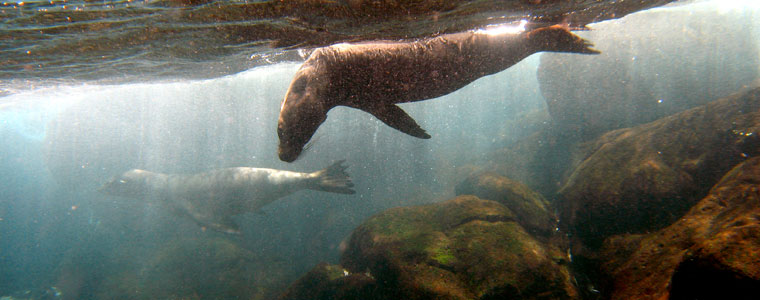
- Sea lions & sea birds, which compete with the commercial fisheries for the limited supply of fish.
Although this event can be devastating for marine life, the increased precipitation actually helps the lush plants in the Galapagos Islands to flourish. Typically, El Niño years see a large growth of foliage on land.
Ultimately, this should not deter people from traveling. Certain sites may be closed for conservation or safety purposes, and there will probably be fewer fish and iguanas; however, you most likely won’t even notice, and the wildlife you do see will be in rare form as they compete for the limited natural resources.
El Niño’s impact on mainland Ecuador
Super El Niños tend to cause a lot of problems in coastal regions of mainland Ecuador.
- When the rains begin, municipal storm drains that are close to sea level quickly become overwhelmed, causing the streets to flood in major cities like Guayaquil.
- Small towns in the countryside are often cut off from city access due to excessively muddy and impassable roads.
- Landslides can be very dangerous for communities built on hillsides.
- Flash floods often displace livestock or even entire houses and cause water supplies to become contaminated.
