
| Download Document |
 |

|
Terms to Know
- Landings: Landings are how you arrive to the visitor sites. Each site is visited by dinghy, also known as zodiac or panga.
- Panga: Panga is the Spanish term for dinghy or zodiac. You will hear this word often.
- Dry Landing: Upon arrival to the visitor site you will not have to enter the water when exiting the zodiac or dinghy.
- Wet Landing: Upon arrival to the visitor site you will exit the dinghy by entering the water first, then walking ashore.
- No Landing: There will be no landing because activity will consist of panga ride or snorkeling.
- Dinghy Ride: The dinghy ride is a simple ride on the water around the visitor area. This is done when there is no landing permitted or to get a better view of nearby wildlife or landscapes.
- Possible Activities: All activities are to be ultimately decided by the guide considering weather, sea conditions, and other factors.The activities listed in all itineraries are the final decision made by the Galapagos national park officials with the best interest of the islands in mind. These cannot be altered in any way.
Saturday to Saturday
Isabela Fernandina & Española Islands
Day 1 (Saturday) – Arrival and Chinese Hat
ARRIVAL TO BALTRA ISLAND (GALAPAGOS)

Assistance will be provided upon your arrival by An Ocean Spray representative after passing through immigration and baggage claim. When ready, you will be transferred to the yacht. You will then be shown to your cabin where you will have some time to settle in before the welcome briefing and lunch.
PM: CHINESE HAT
Chinese Hat: This small island is located in the central area of Galapagos, just of the south eastern tip of Santiago Island. It is named after its unique cone hat looking shape formed from volcanic activity many years ago.The visit offers rare, up close viewing of Galapagos wildlife and well preserved remnants of fragile volcanic rock that can't be found in such a unique condition anywhere else. The islet is home to a colony of sea lions on the white coral sand beach.
| CHINESE HAT | |
| Possible Activities: | A hike of 400 meters starting at the beach rising up to 160 feet exploring the different volcanic remnants and rare plant life along with amazing views; Snorkeling among White-Tipped Reef Sharks and various tropical fish. |
| Difficulty: | Moderate |
| Type of Landing: | Wet Landing |
| Highlights & Animals: | White-cheeked Pintail Ducks, colorful fish, sea lions, Brackish Water Lagoon, penguins, and the Galapagos Hawk. |
Day 2 (Sunday) – Vicente Roca Point & Espinosa Point
AM: ISABELA ISLAND – VICENTE ROCA POINT

Isabela Island: This is the largest of all the Galapagos Islands, about 120 km long, and is peculiarly shaped like a sea-horse! It is one of the few islands that are populated. The last census that was taken estimated about 2,200 people living on the Southern part of the Island. The island was formed by 6 different shield volcanoes from North to South that erupted continuously, eventually joining together to form on entire land mass. Of all the islands in the archipelago, Isabela is the most active with the latest eruption coming from Wolf Volcano in May of 2015. There are lots of unique wildlife on Isabela such as the pink iguana, and more wild tortoises than any other island with a different type of species near each of the 6 volcanoes.
Vicente Roca Point: On Vicente Roca Point the geological formations are simply outstanding and it is a great place to view various bird species such as blue-footed boobies, Nazca boobies, gulls, storm petrels, and brown noddy terns. Activities here are all done on the water by either dinghy or panga, or snorkeling. On this western part of the island the Cromwell Current provides cold water and many nutrients. Due to this it is possible to see various feeding frenzies of an assortment of animals such as whales, dolphins, sea lions, and marine birds diving. At times it may also be likely to see fur seals.
| VICENTE ROCA POINT | |
| Possible Activities: | Snorkeling and dinghy ride |
| Difficulty: | Easy / Moderate |
| Type of Landing: | No Landing |
| Highlights & Animals: | Blue-footed boobies, Nazca boobies, sea lions, fur seals, whales. Snorkel - various tropical fish, sea turtles and other marine animals. |
PM: FERNANDINA ISLAND – ESPINOSA POINT
Fernandina Island: No foreign species have ever invaded Fernandina Island and therefore it is one of the world’s most pristine island ecosystems. It is one of the most active islands and is the westernmost island in the archipelago. The volcano “La Cumbre” dominates the landscape with lava fields reaching the ocean. The Cromwell Current also flows on the west making the cold and nutrient rich water an ideal habitat for the Galapagos Penguin and Flightless Cormorant that nests here.
Espinosa Point: This area on Fernandina also provides a great opportunity to see the Galapagos Hawk. Land iguanas are found on the inner parts of the island near the volcanoes caldera and marine iguanas will nest on the coast during certain times of the year. There is only one visitor site to Fernandina which may involve a hike or snorkeling opportunity, making the rest of the island unspoiled in a most natural state.
| ESPINOSA POINT | |
| Possible Activities: | Hike or Snorkel |
| Difficulty: | Easy/Moderate |
| Type of Landing: | Dry/Slippery |
| Highlights & Animals: | Flightless cormorant, Active Volcano, La Cumbre, various types of impressive lava formations, AA lava, Marine Iguanas, occasional land iguanas, Galapagos penguins, sea lions and sally light foot crabs. Snorkel – marine iguanas, colorful species of fish, eagle rays, sea turtles. |
Day 3 (Monday) – Tagus Cove & Urbina Bay
AM: ISABELA ISLAND – TAGUS COVE

Tagus Cove: This visitor site is located on the upper west part of the island and was named after and English war ship that used to pass the islands in the 1800´s. This was a famous spot for many pirates and sailors who have even left their names and the names of the ship inscribed on volcanic rock. There are many different characteristics of the island here from various volcanic activities such as large volcanic rocks or small little balls of petrified rain. On the hike the path leads to Darwin Lake with a tuff cone.
| TAGUS COVE | |
| Possible Activities: | Hike, Kayaking, Panga Ride, or Snorkel |
| Difficulty: | Easy/Moderate |
| Type of Landing: | Dry Landing |
| Highlights & Animals: | Galapagos penguins, flightless cormorant, finches, land iguanas, large-billed flycatchers, hawks, land birds and remnants of past pirates and sailors. Snorkel – Galapagos penguins, various species of fish, sea turtles. |
PM: ISABELA ISLAND – URBINA BAY
Urbina Bay: A bit more south of Tagus Cove is Urbina Bay. Urbina Bay is an interesting site due to the uplifts of the island caused by volcanic and tectonic activity. When it rose, so did the corals and reefs that were under the surface. You can still see them although they are beginning to deteriorate due to air exposure. There are chances of seeing giant tortoises, land iguanas, and more flightless cormorants near the coast.
| URBINA BAY | |
| Possible Activities: | Hiking and snorkel |
| Difficulty: | Easy / Moderate |
| Type of Landing: | Wet Landing |
| Highlights & Animals: | Exposed coral reef, giant tortoises, Galapagos hawk, land iguanas, flightless cormorants. Snorkel – green sea turtles, larger fish, Galapagos penguins. |
Day 4 (Tuesday) – Elizabeth Bay & Moreno Point
AM: ISABELA ISLAND – ELIZABETH BAY

Elizabeth Bay: A visitor site on the way down to the southern parts of Isabela Island is Elizabeth Bay. There are a series of islets, a lagoon and mangroves surrounding it. The mangroves provide a great place to observe many birds and at the lagoon it is possible to see sea turtles resting and feeding.
| ELIZABETH BAY | |
| Possible Activities: | Panga Ride |
| Difficulty: | Easy/Moderate |
| Type of Landing: | No Landing |
| Highlights & Animals: | Sea turtles, red and black mangroves, lava herons, Galapagos penguins, rays, flightless cormorants. |
PM: ISABELA ISLAND – MORENO POINT
Moreno Point: On the South Western point of Isabela Island is Moreno Point. With striking black geological features it is home to endemic species known only to the barren lava flows found here. Various activities are possible such as a hike, a panga ride to better see various sea birds, geological features, and snorkeling to view the vibrant underwater life.
| MORENO POINT | |
| Possible Activities: | Panga Ride, Hike, Snorkeling |
| Difficulty: | Moderate / Difficult |
| Type of Landing: | Dry Landing |
| Highlights & Animals: | Common gallinules, flamingos, paint-billed crakes, white-cheeked pintails, sea turtles, white-tipped reef sharks, pintail ducks. Snorkeling – assortment of fish, sea lions, green. |
Day 5 (Wednesday) – Charles Darwin Center & Highlands
AM: SANTA CRUZ – CHARLES DARWIN RESEARCH STATION

Santa Cruz Island: Today Santa Cruz is one of the most popular tourist sites. With a population of about 12,000 Galapagos natives, it has the longest paved road in the entire archipelago. One of the biggest conservation efforts is to eliminate all non-native plants and animals that are destroying native and endemic species on the island. There is no longer any volcanic activity but that does not mean there is no evidence. Santa Cruz means holy cross, but it' s English name comes from the British vessel – Indefatigable.
Charles Darwin Research Station: The station conducts many different research projects and provides assistance to other researchers and governmental institutions and agencies, especially the Galapagos National Park. Many of the results are later published online, in magazines, and popular scientific journals. The research station also plays a big part in educating the community and public schools in Galapagos. There is also the longtime running Giant Tortoise restoration program that includes various stages of the giant tortoise from eggs, hatchlings and adults.
| CHARLES DARWIN RESEARCH STATION | |
| Possible Activities: | Walk |
| Difficulty: | Easy |
| Type of Landing: | Dry Landing |
| Highlights & Animals: | See the latest advances in research at the Charles Darwin Research Station. Also see Giant Tortoises and land iguanas. |
PM: SANTA CRUZ – HIGHLANDS
Highlands: In the highlands you can walk along a path made to observe the hills, ferns, volcanoes, and rich wildlife. This area is home to giant tortoises, mockingbirds, Bahama ducklings, White-cheeked Pintails, Darwin finches and many other species. Lava tubes here are more than half a mile long. Walking along these lava tubes is a unique and surreal experience.
| HIGHLANDS | |
| Possible Activities: | Hike/Walking |
| Difficulty: | Moderate |
| Type of Landing: | Dry Landing |
| Highlights & Animals: | Giant Tortoises in the wild, lava tubes, various bird species. |
Day 6 (Thursday) – South Plaza & Santa Fe
AM: SOUTH PLAZA ISLAND
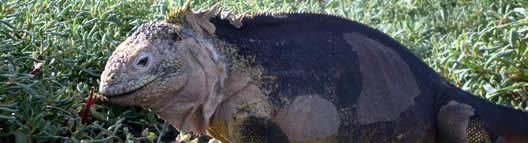
South Plaza: South Plaza is one of the smallest islands with a visitor site, but is home to an incredible amount of diverse flora and fauna. It has a large population of Sesuvium plants like the prickly pear cactus tree that is an important source of food for the land iguana. Just a few years ago mice were finally eradicated from the island, helping the population of land iguanas grow healthily once more.
| SOUTH PLAZA | |
| Possible Activities: | Short hike, Panga ride, Kayaking |
| Difficulty: | Easy |
| Type of Landing: | Dry landing |
| Highlights & Animals: | Cacti native only to South Plaza, land iguana, finches, sea lions, swallow tailed gulls, red-billed tropicbirds. |
PM: SANTA FE ISLAND
Santa Fe: Santa Fe Island is home to the unique Santa Fe land iguana and is the only place to find Opuntia cactus. Giant tortoises were once native to this island but after the many years of pirates and buccaneers visiting the island and taking the tortoises aboard as food, they became extinct. The Island is also called Barrington Island, named after British Admiral Samuel Barrington. Large numbers of sea lions can be found on the landing beach and Galapagos hawks can also sometimes be seen.
| SANTA FE ISLAND | |
| Possible Activities: | Short Hike, Panga Ride, Kayaking |
| Difficulty: | Easy |
| Type of Landing: | Wet Landing |
| Highlights & Animals: | Galapagos hawk, Santa Fe land iguana, Opuntia Cactus, sea lions, lava lizards. |
Day 7 (Friday) - Suarez Point & Gardner Bay/Osborn Islet
AM: ESPAÑOLA ISLAND: SUAREZ POINT

Española Island: Here lies the southernmost island in the Galapagos, as well as the oldest. It is estimated to be about four million years old. Because it is so far away from the other islands it has the most endemic species. It is a wonderful opportunity for some great photography of endemic bird species that are found only on Espanola and awesome landscapes created by millions of years of erosion.
Suarez Point: This is a phenomenal site where you will get to see many of Española Island's endemic species. The trail will pass by the only Waved Albatross breeding site. If you are lucky you might see a young albatross take off for its first flight for up to five years at sea. Older birds stay at sea for months at a time, only coming back to breed. They have the same mate for life and will meet each other each year, only here to reproduce. Other species that can be seen are marine iguanas that stay brightly colored year round, Galapagos doves, Nazca boobies, blue-footed boobies, swallow-tailed gulls, red-billed tropic birds, and Darwin finches.
| SUAREZ POINT | |
| Possible Activities: | Hike |
| Difficulty: | Moderate |
| Type of Landing: | Dry landing |
| Highlights & Animals: | Only Waved albatross breeding site, blow hole on the point, Nazca boobies, swallow tailed gulls, red-billed tropic birds, three different species of finches, Galapagos doves, marine iguanas, sea lions. |
AM: ESPAÑOLA ISLAND: GARDNER BAY / OSBORN ISLET
Gardner Bay/Osborn Islet: Visit one of the best beaches in the Galapagos. The white sandy beach is home to a large colony of friendly and playful sea lions. Three different types of finches can be seen. The Espanola Mockingbird is very friendly, but probably looking for food. At one point in time, tourists must have given it water or food, which taught them bad habits. The site is also where green sea turtles will come to nest their eggs between January and March.
| GARDNER BAY / OSBORN ISLET | |
| Possible Activities: | Walk, Snorkel, Panga Ride |
| Difficulty: | Easy/Moderate |
| Type of Landing: | Wet Landing |
| Highlights & Animals: | Española mockingbird, longest beach in Galapagos, three species of Darwin's finches, large colony of sea lions, occasional green sea turtles. Snorkel – coral fish, sea lions, and other marine life. |
Day 8 (Saturday) – Interpretation Ctr. / Galapaguera & Departure
AM: SAN CRISTOBAL ISLAND: INTERPRETATION CENTER / GALAPAGUERA

San Cristobal Island: This is the fifth largest island in the Galapagos and lies farthest East. It is where Darwin first landed back in 1835 and where the first permanent settlements were founded. Today the main port Puerto Baquerizo Moreno is the capital of the Galapagos province and houses many government offices, the Ecuadorian Navy, and an airport with daily flights to the mainland of Ecuador. Conservation challenges the island faces include invasive plants like blackberry and guayaba and insects like the blackfly.
Interpretation Ctr./Galapaguera: The Interpretation Center has been open to the public since 1998 and offers extensive information about the history of Galapagos, all ecosystems, geology, and flora and fauna. Giant tortoises are also bred here by the center and roam about in a semi-natural habitat created by the centers employees. Within the center are meeting rooms, interpretational panels, auditoriums, exhibits, and much more.
| INTERPRETATION CENTER / GALAPAGUERA | |
| Possible Activities: | Walk |
| Difficulty: | Easy |
| Type of Landing: | Dry Landing |
| Highlights: | Giant tortoises up close and roaming freely, exhibits of various stages of tortoise breeding, learn more about origin, evolution, natural habitat, and threats of introduced animals and plants. |
TRANSFER TO SAN CRISTOBAL AIRPORT
Your cruise has officially come to an end. We hope you enjoyed your Galapagos Cruise! We will now transfer you to your scheduled departure from San Cristobal Airport to mainland Ecuador. Safe travels!
Important: Itineraries and activities are subject to change without prior notice. Depending on weather conditions and water currents, some wildlife described above may not be visible. The wildlife described is not guaranteed to be seen during your visit. Please remember to respect your distance between any and all wildlife. Please stay on marked trails and heed the directions of your Naturalist Guide. |
